
What a Palantir Ontology-Powered Supply Chain Command Center Actually Changes
Most supply chain teams do not lack dashboards.
They lack an operating layer.
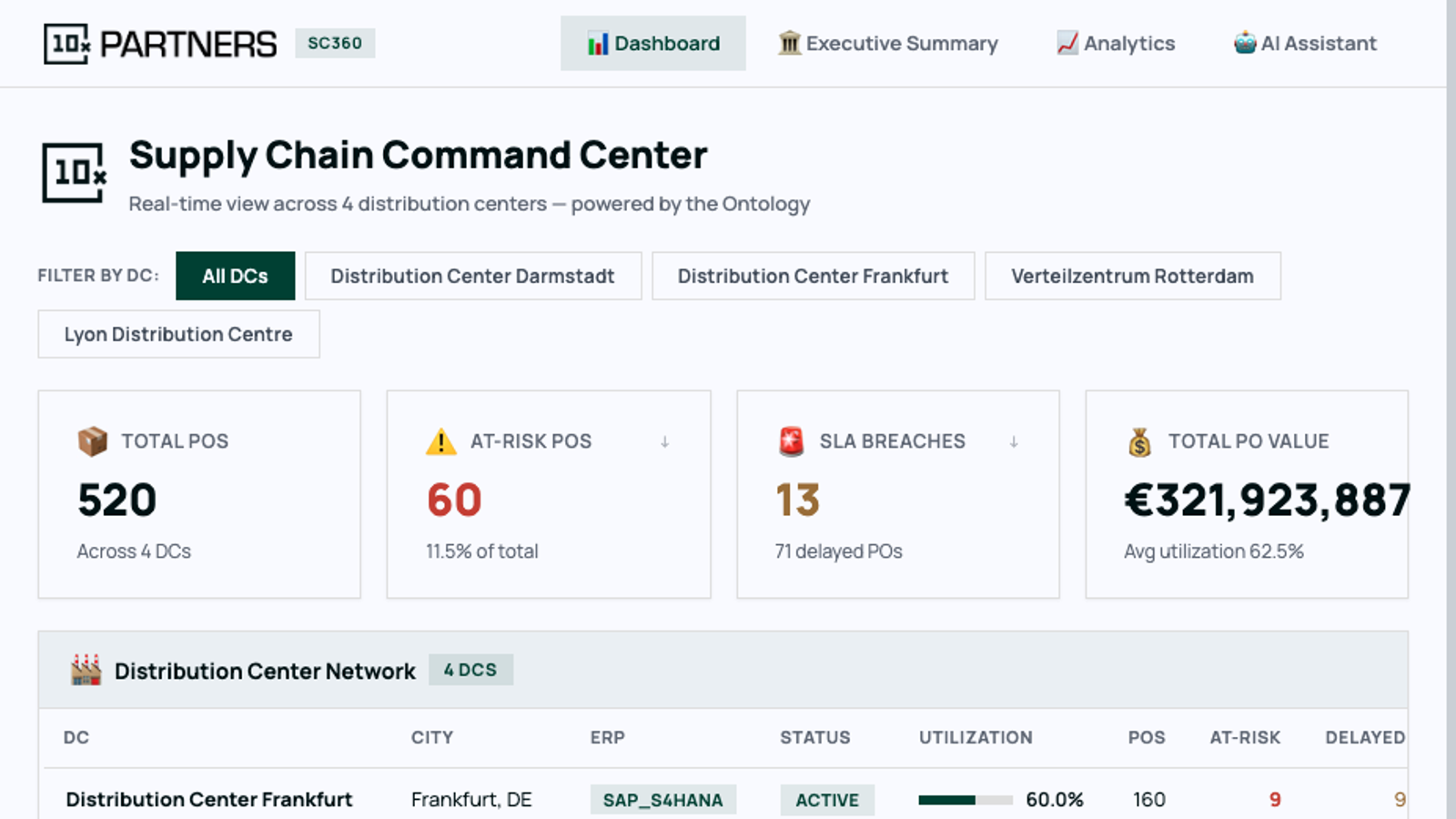
That is exactly what the SC360 demo makes visible. The scenario is simple and realistic: 3 acquired companies, 3 different ERPs (SAP S/4HANA, SAP ECC6, Oracle EBS), and 5 distribution centers across Europe. Databricks has already done the ingestion and normalization work. The gold tables are ready. The problem is that the procurement team still cannot get answers fast enough to operate.
A control tower can show delays, inventory, and supplier issues. But if buyers, planners, DC leaders, and logistics teams still have to reconstruct the same problem across separate systems before acting, visibility has not really become control.
That is where a real command center changes the game.
Why Most Supply Chain Visibility Still Under-Delivers
A lot of supply chain tooling still stops at observation.
You can count at-risk POs. You can filter by distribution center. You can highlight late shipments. You can even predict some exceptions.
But operations do not improve just because the signal is visible on a screen.
They improve when the people responsible for procurement, inventory, transport, and service-level recovery can read the same situation through the same operating model and act from it fast.
That is the gap most control towers never close.
The Real Shift Is Structural
A proper command center is not just a dashboard layer on top of disconnected tables.
In the demo, that shift happens when 7 Databricks datasets are turned into one Foundry ontology linking DCs -> POs -> Suppliers -> Shipments -> Carriers -> Inventory.
It becomes valuable when the business entities are connected in a way teams can actually use:
- distribution centers,
- purchase orders,
- suppliers,
- shipments,
- carriers,
- inventory positions,
- SLA risk,
- and the actions attached to them.
Once those relationships are explicit, the conversation changes.
A planner is no longer asking three teams to reconcile whether a delay matters. The impact path is already visible. A buyer can see which supplier issue affects which PO, which DC, which shipment, and which service-level risk. An operator can prioritize intervention based on consequence, not just based on whichever email arrived first.
That is what an ontology-powered command center actually unlocks.
The difference is not just visibility. Buyers, planners, and logistics teams can work from the same operating context, prioritize by consequence, and act before delay compounds.
From Static Views to a Living Supply Chain Model
The difference is easiest to see in multi-ERP environments.
This is where supply chain operations become slow for structural reasons. One acquired company runs SAP S/4HANA. Another still runs ECC. A third runs Oracle EBS. Databricks may already be normalizing the data into gold tables. That helps. But it still does not give the procurement team a live way to understand what is happening right now.
A Palantir Foundry ontology changes that by turning normalized data into an operating model.
The point is not simply to ingest more records. The point is to make the business legible in operational terms. Teams stop navigating tables and start navigating the supply chain itself.
What Changes for Operators
The first change is speed.
When at-risk purchase orders, SLA breaches, and shipment delays are visible in one environment, the team spends less time assembling context and more time deciding what to do. In this demo, that is not just a prettier table. The AI assistant can traverse the graph in 4 hops, which means a user can move from one supplier issue to the affected purchase orders, shipments, distribution centers, and inventory consequences without rebuilding the chain manually.
The second change is prioritization.
Not every delay matters equally. A useful command center shows consequence, not just exception volume. Which DC is affected? Which customer commitment is at risk? Which supplier issue is still recoverable? Which shipment is worth expediting?
The third change is actionability.
This is where most reporting products stop. A real command center does not just surface the issue. In the SC360 build, the same interface already exposes 5 ontology actions. That is the important shift: the team can escalate, flag, or intervene from the place where the risk becomes legible.
That is what makes the difference between monitoring and operating.
Why the AI Layer Matters
The AI layer matters for the same reason the ontology matters: it reduces translation cost.
In a strong setup, a user does not need to know which table to query or which dashboard to open. They can ask the system directly and traverse the operational graph through natural language.
That matters much more than it sounds.
It means the command center is not limited to pre-built views. It becomes explorable. It can hold context across sessions. And when the underlying operating model is solid, it can support real actions from the same interface rather than sending users back into fragmented workflows.
The result is not just better UX. It is faster operational comprehension.
Why This Matters Beyond the Demo
The demo itself is compelling because it compresses what teams usually assume will take weeks.
In this case, the key proof point is explicit: the team built the demo in 1 day with synthetic data, not in a multi-week sprint. That matters because it changes the commercial conversation. You can show the operating pattern fast, test whether the ontology model is useful, and prove the interaction model before a long delivery cycle begins.
But the deeper point is not speed of demo assembly alone. It is what the demo proves.
It proves that supply chain visibility can move beyond static reporting. It proves that teams can work on a shared representation of the business instead of separate extracts. It proves that a command center can connect live signal, reasoning, and action.
That is why this matters for real operations teams, especially after acquisitions, in multi-site environments, and anywhere service-level pressure makes latency expensive.
Final Thought
Most supply chain organizations already have enough dashboards.
What they still lack is a system that lets teams operate from the same truth while there is still time to intervene.
That is what a command center should change.
Not the aesthetics of visibility.
The speed and quality of execution.
Remi Barbier