Ski resorts already have data.
They just do not operate from it.
Lift SCADA, RFID gates, weather feeds, webcams, grooming telemetry, dispatch radios, staffing sheets, snowmaking controls, ticketing systems, and P&L views all exist somewhere. The problem is that they still sit in separate operational worlds.
That is why resort teams often run the mountain through radio, habit, and delayed interpretation instead of through one live operating model.
Why Resorts Still Operate in Fragments
The issue is not digitisation in the abstract.
Many resorts already have modern systems. They have Axess or Skidata for skier flows. They have lift IoT. They have weather services. They have cameras. They have slope sensors. They have HR tools. They have ticketing. They have finance reporting.
What they usually do not have is one place where these signals become operationally legible together.
That fragmentation has real consequences.
A rescue event is still coordinated by radio and memory. Lift speed is adjusted without a live view of actual queue pressure. Grooming decisions are made without combining snowpack deficit, demand, and weather. Revenue teams know ticketing, but not always the operational conditions shaping skier behaviour on the mountain that same day.
That is the core problem.
The First Shift: Costs Become a Systematic Choice
Resort operations carry heavy fixed and semi-variable costs: lifts, grooming, snowmaking, maintenance, payroll, and energy.
Most optimisation efforts still happen as local decisions, not as a connected operating system.
A better pattern is straightforward.
Lift speed responds to real queue density instead of default settings. Grooming plans adapt to actual snowpack deficit rather than to static routes. Snowmaking respects weather and hydrology thresholds dynamically instead of being driven by isolated SCADA logic. Maintenance signals travel before the breakdown instead of after it.
That is what an operating system changes. It turns recurring operational judgement into a repeatable decision layer.
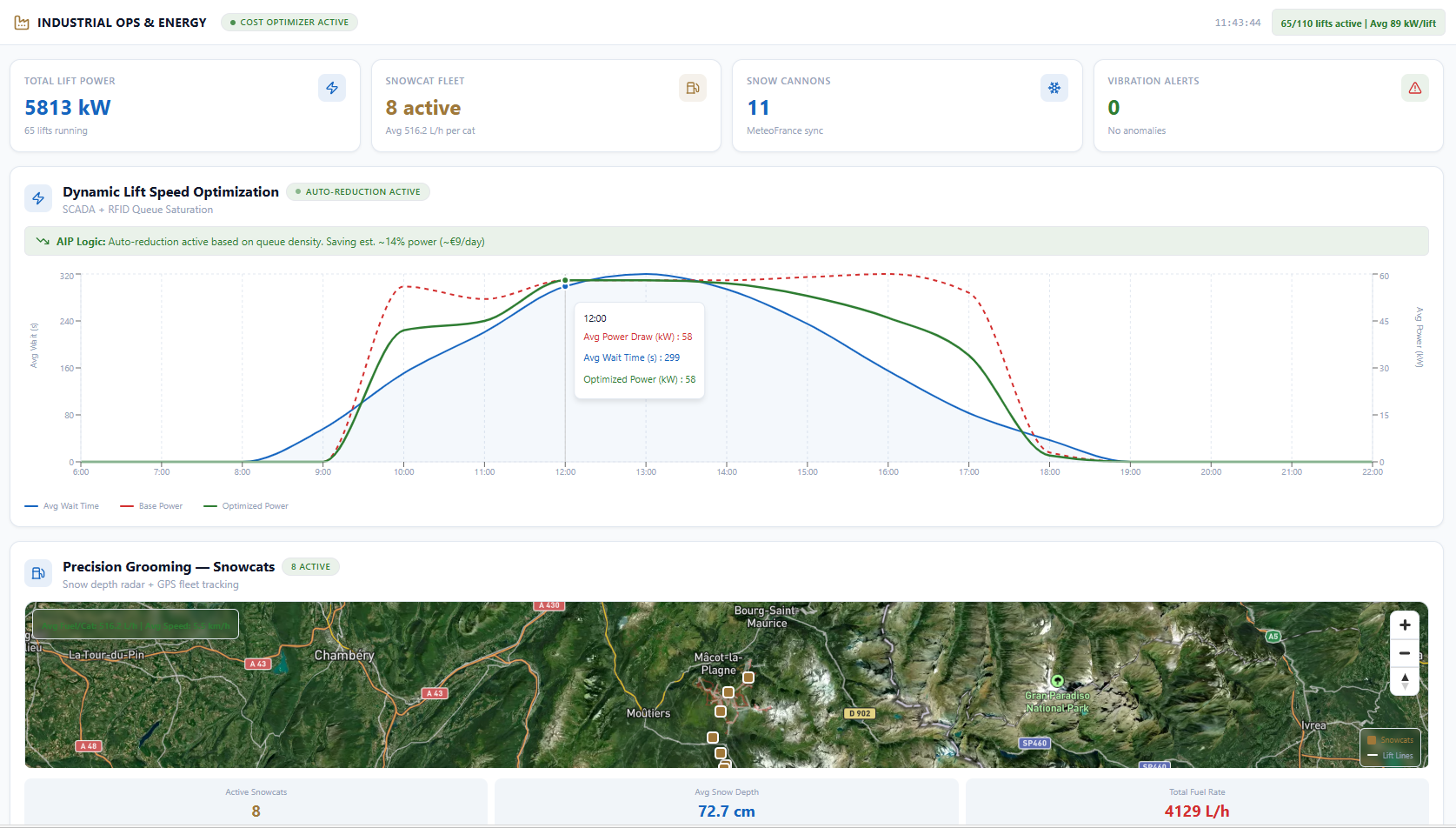
One operating layer can turn lift energy, snowmaking, and demand signals into live decisions instead of separate local optimisations.
The Second Shift: Safety Stops Running on Radio Alone
This is one of the clearest areas where latency matters.
In many resorts, dispatch is still a human relay problem. Someone hears the incident. Someone interprets it. Someone tries to identify the best responder. Documentation is partial. Auditability is weak.
A better setup links incidents, patroller GPS, terrain profile, weather conditions, skier density, and response history in one model.
Then dispatch stops being a memory-based process.
It becomes a live recommendation problem. Who is closest? Who is qualified? Which route is best? What was known at the time of the decision? The answer is not only faster response. It is also better legal protection and a real audit trail in high-liability situations.
The Third Shift: Revenue and CRM Start Using the Mountain Itself
Revenue in a resort is not just a pricing question.
It is a flow question.
Dynamic pricing, skier engagement, anti-fraud detection, retail and F&B cross-sell, and sector-level profitability all improve when the commercial layer is connected to the operating reality of the resort.
If skier flow, wait times, weather, closures, and sector usage are live, pricing and engagement can stop relying on static assumptions.
That means ticketing can react to actual pressure. CRM can push skiers toward underused zones. Fraud detection can move from suspicion to anomaly detection. Management can compare revenue and staffing decisions against the real shape of the day rather than against a delayed summary.
The Fourth Shift: ESG Moves From Reporting to Operations
This is where a lot of mountain groups still underuse the data they already have.
Water, diesel, electricity, and carbon impact are often reconstructed after the season or after the reporting cycle. That is useful for compliance. It is weak for operations.
A real operating model changes the sequence.
Snowmaking, grooming, lift energy, and hydrology thresholds become live management inputs. Carbon audit trails stop being a manual afterthought. ESG becomes something the resort can actively manage while the season is running, not just explain after it ends.
That shift matters more as reporting requirements tighten and resource pressure increases.
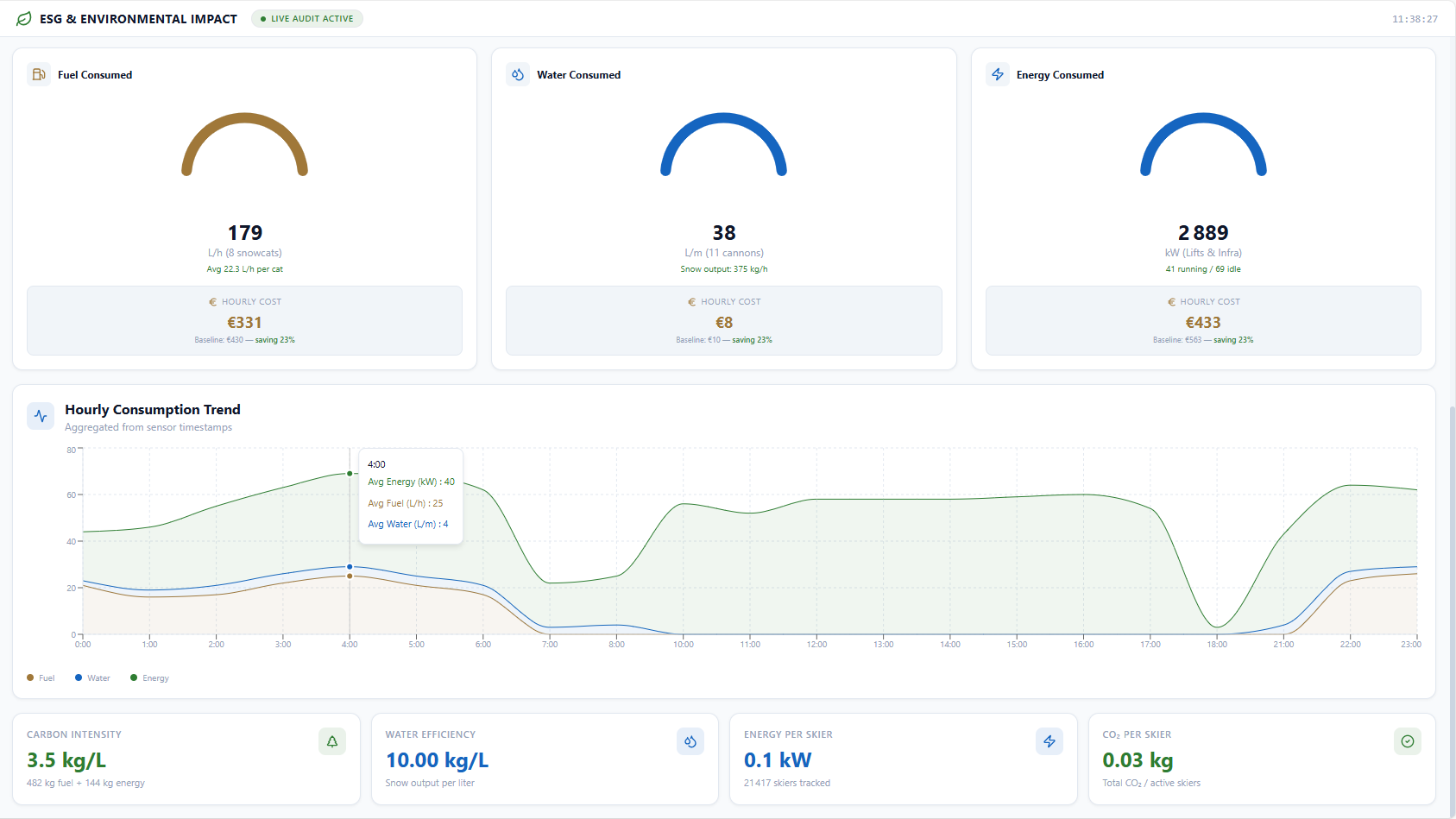
When water, energy, and carbon signals are operationalised in-season, ESG stops being a reporting exercise and becomes a management capability.
The Fifth Shift: Management Finally Gets a Command Center
Most mountain leadership teams still do not have one operational screen they can trust.
They have separate dashboards, team updates, local views, and a lot of implicit knowledge. That works until pressure rises: weather turns, incidents cluster, one sector overloads, a closure redirects traffic, or staffing mismatches start compounding.
A command center only becomes valuable when it is built on a live operating model.
Then it can combine incidents, patrollers, lifts, skier flow, snowmaking, grooming, weather, risk scores, staffing, and sector P&L in one tactical cockpit. And once that exists, simulation becomes possible. What happens if we close this run? What does that do to adjacent wait times? What does tomorrow's demand imply for staffing and pricing? Which sector is underperforming operationally and commercially at the same time?
That is where the system stops being a dashboard layer and starts becoming a management tool.
Why This Matters Strategically
The strongest part of this category is not one isolated use case.
It is the compounding effect across the mountain.
Cost optimisation, safety, revenue, ESG, and command center value all get stronger when they run on the same operating model. That is why siloed point solutions keep leaving value on the table. They solve one problem at a time. They do not turn the resort into something management can operate coherently.
That is the real opportunity.
Not another ski-tech feature. A real resort operating system.
Final Thought
A ski resort operating system is not really about having more data.
It is about turning the mountain into a live model that operations, finance, safety, and commercial teams can all act from while there is still time to improve the day.
That is what actually changes.
Remi Barbier