Manufacturing rarely has a data shortage.
What it usually has is a timing problem.
The plant knows something is drifting before the report shows it. Procurement sees a supplier issue before planning has absorbed it. Quality sees the symptom before anyone can clearly trace where it started.
That is why so many manufacturing transformations feel underwhelming. The dashboards improve. The reports improve. The coordination burden does not.
When Foundry lands well in a manufacturing environment, the change is not cosmetic. The business starts operating on a live model instead of a patchwork of delayed views.
Why Manufacturing Feels the Problem Faster
Manufacturing punishes latency more brutally than most sectors.
A delayed signal in a plant or supply chain does not stay theoretical for long. It becomes scrap, downtime, missed service levels, supplier problems, excess working capital, or a production plan that no longer matches reality.
Industrial companies also rarely run on one clean stack. They run on layers that have accumulated over years: ERP, MES, historians, quality systems, planning tools, spreadsheets, supplier portals, and local workarounds.
Each one is understandable in isolation. Together, they create the operational fog that slows action down.
In many environments, that means 5 to 15 disconnected systems per business unit before anyone even starts talking about AI. In the same material set, the related "silo tax" estimate is that integration work can consume roughly 25% of annual IT budget before the business gets any real operating leverage.
The First Real Shift: Quality Stops Being a Checkpoint
In many manufacturing environments, quality control still behaves like a checkpoint.
Teams inspect, sample, report, escalate, and then decide what to do. That works when defects are rare and the cost of delay is manageable. It breaks when quality needs to be continuous, traceable, and tied to upstream and downstream consequences.
The better pattern looks different.
Quality signals become part of the operating model itself. Vision models, process data, and supplier performance stop living in separate conversations. A defect pattern can be connected to a supplier lot, a line condition, a shift, a machine state, or a downstream customer impact.
That is when quality stops being a report and starts becoming a control surface.
The Second Shift: Supply Chain Becomes Legible
Most manufacturers do not suffer from a lack of supply chain reporting. They suffer from fragmented supply chain meaning.
Procurement sees one version of the situation. Planning sees another. Plant operations see a third. Sales and customer teams feel the consequence only once service levels move.
Foundry becomes useful when it creates one live chain of context across those functions.
Suppliers connect to components. Components connect to production orders. Production orders connect to inventory and commitments. Commitments connect to customer reality.
This sounds obvious. In practice, many manufacturers still reconstruct that chain manually every time something slips.
The Third Shift: Maintenance Stops Running on the Calendar Alone
Predictive maintenance is one of the most overused themes in industrial software, but the value is real when the surrounding system can support it.
A useful maintenance signal needs to travel into the actual workflow: which asset is at risk, what condition triggered the alert, which production schedule is affected, what spare parts are available, and what the cost of delay looks like.
If those questions require jumping across separate tools and teams, the model remains interesting but operationally weak.
Foundry changes that when the maintenance signal is treated as part of the operating system rather than as a standalone prediction.
That is also where the economics become credible. In the material we have built around this category, the recurring proof pattern is not marginal improvement. It is 5-10x ROI within two to three years and maintenance cost reduction that can reach 40% when the workflow around the model is operationalised properly.
The Fourth Shift: The Second Use Case Arrives Faster
This is where many manufacturing leaders underestimate the platform effect.
The first use case often gets judged like a one-off project. In reality, it matters because it creates the semantic and operational foundation for the second one.
Once a manufacturer has a live model for plants, lines, assets, materials, suppliers, orders, and exceptions, the next workflow has much less friction.
That is why the second use case often feels dramatically cheaper and faster than the first. The key entities already exist. The relationships are already modeled. The data access pattern is already established.
That reuse effect changes the economics of adoption. The pattern in our recent material is consistent: a first use case in roughly 8 weeks, then a second in closer to 2 weeks on the same Ontology foundation.
That compounding effect is also visible in public proof points around the platform: 7 ERPs harmonised in 5 days, raw-material optimisation compressed from weeks to minutes, and Airbus publicly pointing to +33% acceleration in A350 deliveries once planning and production coordination ran on a unified model.
What Foundry Changes Under the Surface
The common thread across quality, supply chain, and maintenance is not a specific dashboard or AI feature.
It is the move from disconnected system views to a shared operational model.
That shared model lets the organization do three things in the same environment:
- Read the current state of the business in operational terms.
- Understand the relationships between the moving parts.
- Act from the place where the problem becomes visible.
That is why Foundry feels different in manufacturing when it is deployed well. It does not just improve reporting. It changes how the organization coordinates under pressure.
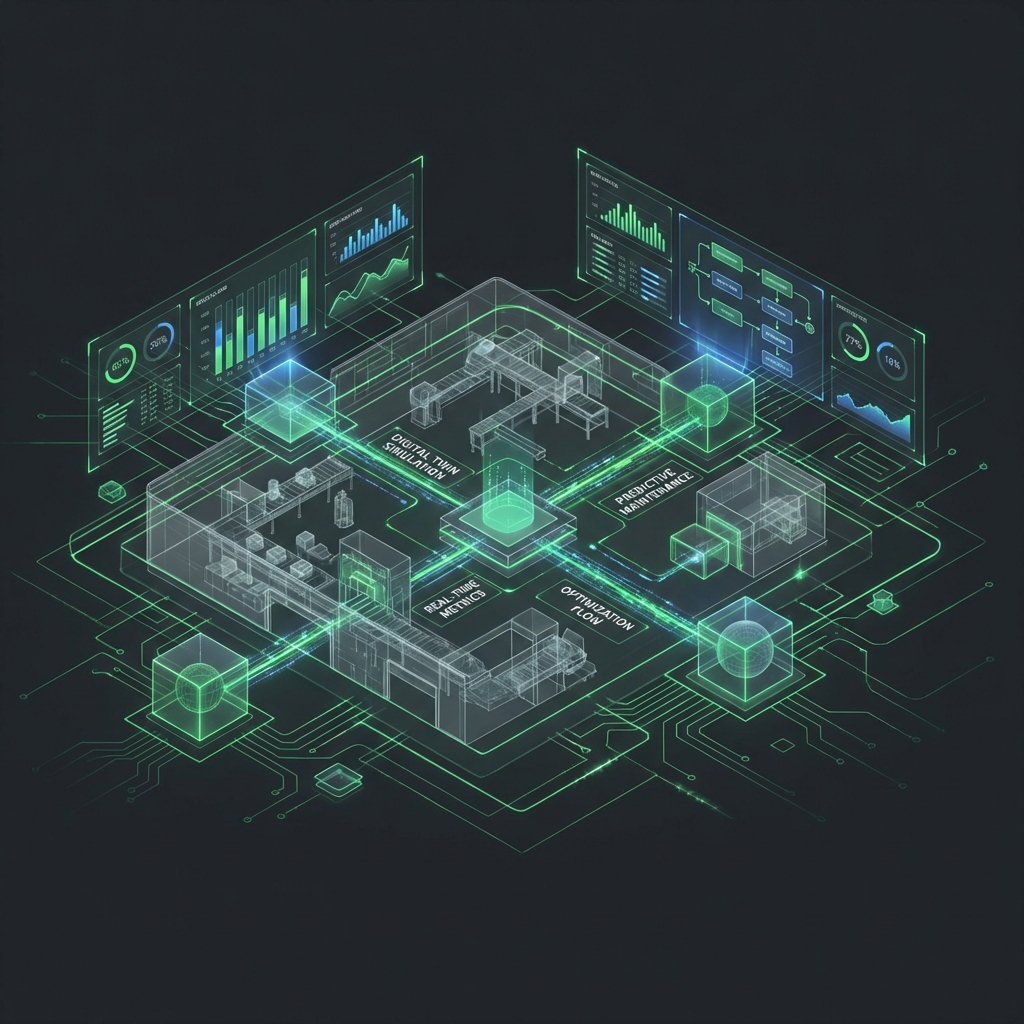
The manufacturing gain is not another dashboard. It is a shared model that links objects, workflows, and actions across quality, supply, and plant operations.
A Better Question for Manufacturing Leaders
The best question is not, "Can Foundry improve our analytics?"
Ask instead:
- Where are we still running the business through disconnected interpretations of the same event?
- Which issue still gets translated across three teams before anyone can act on it?
- Where is latency still turning into scrap, downtime, or service-level risk?
That is usually where the value sits.
Final Thought
Manufacturing does not need more abstract data ambition.
It needs systems that make operations more legible while there is still time to intervene.
That is the change that matters when Foundry lands well: not prettier reporting, but a business that becomes easier to run.
Remi Barbier